The pact, the book and the three threads of Veles
Every Russian fairy tale starts somewhere far away. In a certain kingdom, in a certain land, or further still, past thrice nine lands in the Three-Ninth Kingdom. Forgotten Eras starts there too, with a promise made a very long time ago that has just been broken.
The pact
Long before Ivan, the gods and the people of the Three-Ninth Kingdom agreed to keep to their own sides. The gods would stay in their high places and watch over people and beasts, and their magic would never pass into mortal hands. People swore in return never to reach for the gods' power. People are clever, after all, and give them divine magic and they would remake the world out of ambition alone.
The shamans sealed the pact. They were the gods' servants on earth, and they locked away a book called Forgotten Eras, which held every divine secret: every spell, every road by which a mortal might become a god. Then they stood guard over it.
Only one god saw further than the rest.
Three threads
Veles did not trust the peace. In our story he is the god of shapeshifting, and he expected people to break their word sooner or later. So before the pact was sealed, he left three things in the world, three threads of fate meant to be woven one day into a single future:
- The Grey Wolf, an old and wise beast who protects people and creatures alike.
- The Pure Soul, a wandering spark of real goodness, searching the earth for the one mortal worth making into a hero.
- The Symbol, a rune carved into a headband. Worn by the right person, it binds the wolf and the soul together.
Veles gave the headband to the king of that age and told his line to keep it until evil came back. Centuries went by. The gods kept their promise, people lived simple lives, and the story faded the way stories do.
The shamans who went bad
Corruption grows best in quiet. A faction among the shamans began to want what they were guarding, and for years they studied in secret how to break the seal and take the gods' magic for themselves.
Far from the palace, meanwhile, the king's third son, Ivan, had left court for the forest. There he met Avena, a rusalka, and they fell in love. A human loving a magical being was exactly what the pact forbade.
The loyal shamans warned the king to stop his son or they would. The king knew about the traitors as well, and he was afraid of both sides. When Ivan refused to give Avena up, his father struck him unconscious and put the old headband on his brow. He remembered one thing from the old stories: its rune hides the one who wears it from every shaman, loyal or not. The rest of the prophecy he had forgotten.
Ivan vanished. Nobody knew that the Pure Soul had chosen him on the day he was born. The moment the headband touched him, the Grey Wolf woke from his long sleep and howled across the land, and Ivan opened his eyes alone in a cold forest with three questions. How did I get here? What is this symbol on my head? And what is that howling?
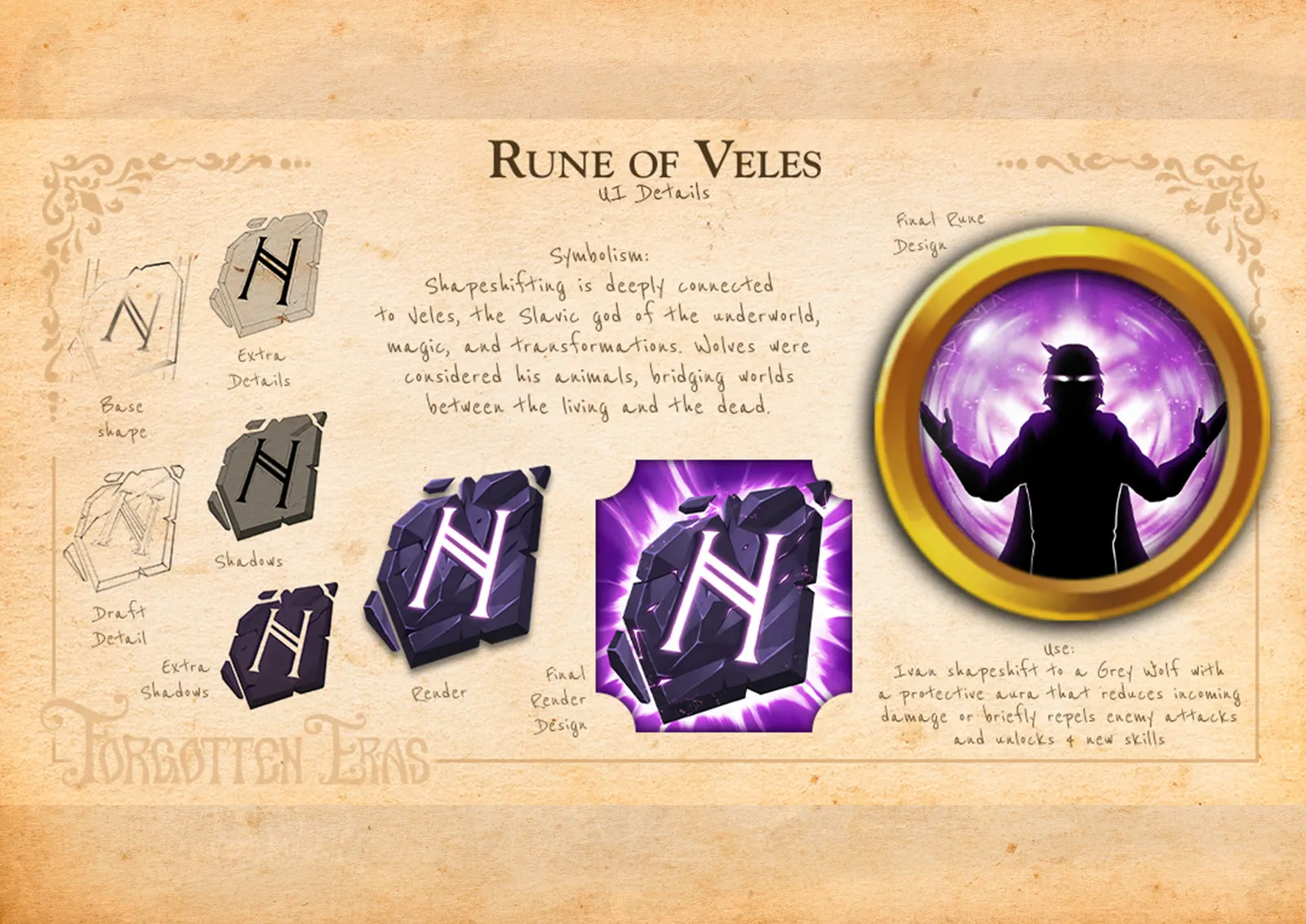
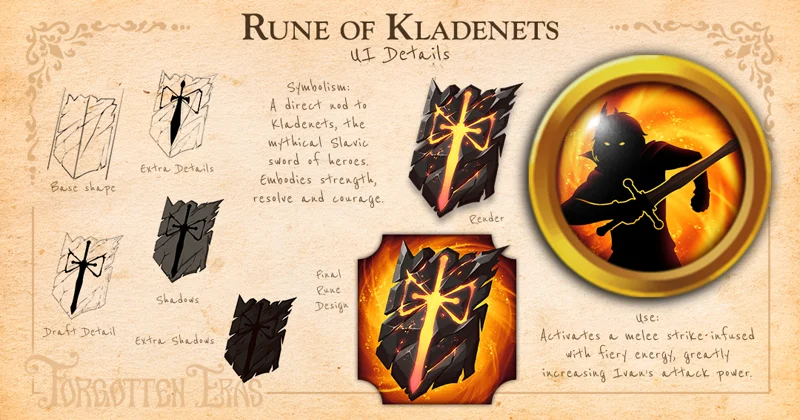
The Rune of Veles as the team drew it for the game's interface, from the first pencil shape to the finished stone. In the game it is the rune that turns Ivan into the Grey Wolf.
What the old sources say
Veles is one of the few Slavic gods whose name survives in the oldest texts of Rus'. When the princes of Kyiv made treaties with Byzantium in 907 and 971, the Primary Chronicle says they swore by Perun and by Volos, "the god of cattle". The Tale of Igor's Campaign calls the bard Boyan "grandson of Veles". That is close to everything the old sources tell us about him directly.
The rest is reconstruction. In 1974 the linguists Vyacheslav Ivanov and Vladimir Toporov argued that Veles was the old adversary of the thunder god Perun, a lord of the underworld, of beasts and of magic, and most of what people say about him today comes from their work. "God of shapeshifting" is our own addition. We took the reconstructed Veles, the lord of beasts and magic, and gave him the one gift our story could not do without.
The shamans have a history too. "Shaman" is a Siberian word, borrowed from the Evenki language. The East Slavs had volkhvs, the pagan priests and soothsayers of the chronicles. Volkhvs foretold that Prince Oleg would die because of his favourite horse, and he did. In 1071, in a year of famine, volkhvs raised the Rostov land against the rich. The chroniclers were monks and never trusted them. In our story the shamans guard the pact, and only some of them betray it.
The Three-Ninth Kingdom
Tridevyatoe tsarstvo, the Three-Ninth Kingdom, is where Russian wonder tales happen: far away, past thrice nine lands, where wolves talk and huts walk on hen's legs. It never had a map. We are drawing one.
Over the next weeks we will write about each of the people in this story: Ivan, the Grey Wolf, Avena, the Domovoy and Baba Yaga. Until then you can meet them on the game page.
Sources: "The Tale as Told by the Fire", Forgotten Eras on Steam, 16 July 2026. The Primary Chronicle, entries for 907, 912, 971 and 1071. The Tale of Igor's Campaign. V. V. Ivanov and V. N. Toporov, Studies in the Field of Slavic Antiquities, Moscow, 1974.